Postindustrial
Peripheries:
A Regional Rethink
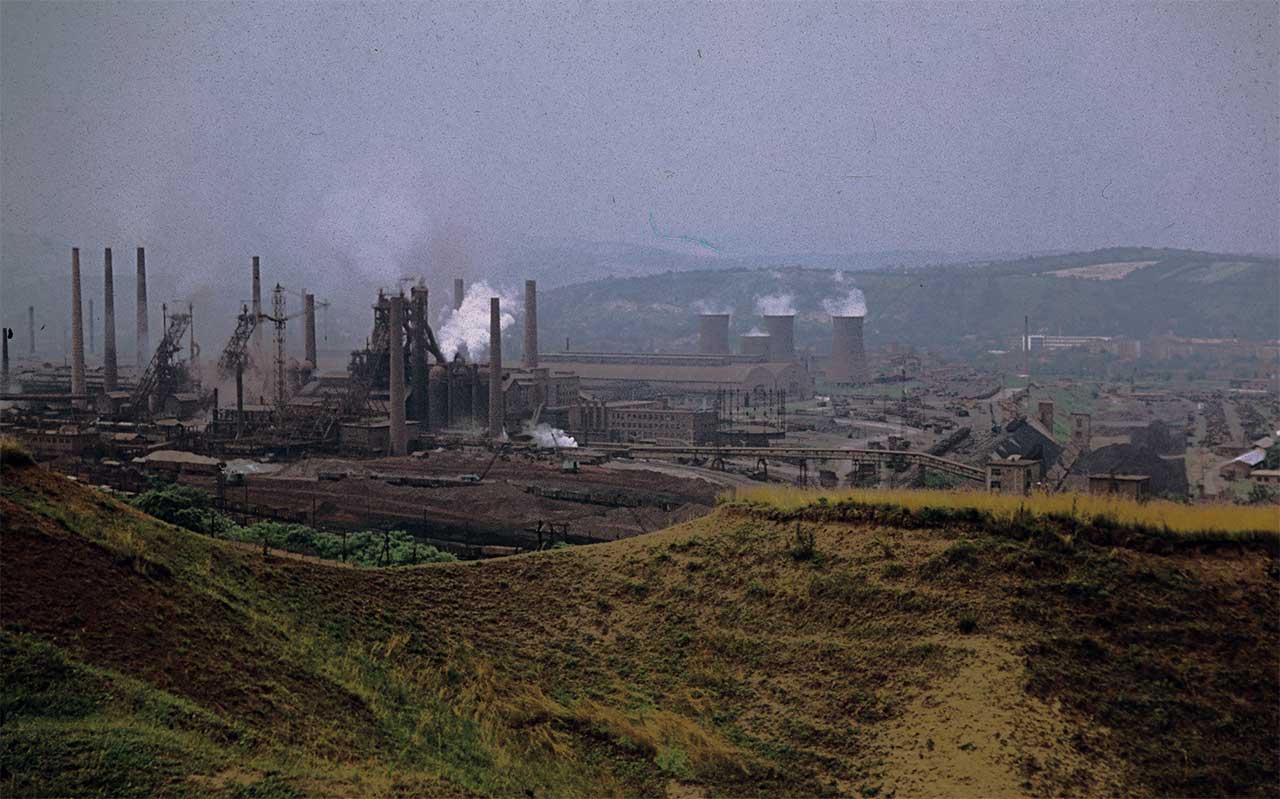
Across East-Central Europe, postindustrial territories — from former mines and quarries to steelworks, chemical plants, and workers’ neighbourhoods — remain among the most complex spaces of the green transition. These landscapes, shaped by decades of extraction, industrial production, and uneven development, embody both ecological degradation and strong local attachments.
Many still carry the material and social legacies of heavy industry, while facing new pressures from disinvestment, spatial fragmentation, and climate risks. Yet they also hold vast potential for renewal: for circular resource use, ecosystem restoration, and social innovation embedded into local circumstances and demands.
Explore The Map
Explore the map below to navigate case study locations across the region — each representing a distinct trajectory of postindustrial regeneration, from industrial corridors and steelworks to workers’ housing estates and landscape-scale brownfields.
Tatabánya: Stone Quarry & Mésztelep Neighbourhood (HU)
A former limestone quarry and its adjacent workers’ neighbourhood illustrate the intertwined environmental and social histories of industrial extraction. Ecological succession is visible on the quarry floor, suggesting potential for multifunctional green development. Mésztelep, shaped by social vulnerability and segregation, lacks adequate public spaces and services, while municipal capacity remains limited. The case highlights the need to integrate ecological restoration, public space renewal, and community-scale initiatives within a long-term regeneration strategy.
Download Case Study Salgótarján: Steelworks, Acélgyári út & Jónástelep (HU)
This case brings together heavy industrial legacies and the decline of a peripheral housing district. The closed Steelworks area remains structurally and environmentally burdened, while Jónástelep faces isolation, infrastructure degradation, and socio-economic challenges. Opportunities lie in micro-regeneration, reconnecting fragmented public spaces, and mobilising heritage as a cultural asset. Governance gaps and limited resources reinforce the importance of incremental, community-driven interventions.
Download Case Study Miskolc: Diósgyőr Ironworks (HU)
Once a major steelmaking centre, the site retains large but deteriorating industrial structures. The adjacent stream offers ecological potential, though remediation is required. Redevelopment has stalled due to ownership fragmentation and high environmental costs, and residents of the nearby workers’ neighbourhood depend on informal networks amid limited public space quality. Still, the area holds potential as a heritage and innovation district where adaptive reuse, ecological restoration, and improved accessibility could converge. The case illustrates the challenge of balancing industrial memory with contemporary economic needs.
Download Case Study Košice–Šaca: Steel District (SK)
A large peripheral industrial zone built around the Steelworks, with a workers’ housing district now facing declining services and growing spatial disconnection. The site shows how industrial monofunctionality continues to influence mobility, air quality, and public space. Potential lies in integrating open land into ecological buffers and piloting mixed-use redevelopment models. Community-led initiatives demonstrate possibilities for social reconnection despite structural constraints.
Download Case Study Veľký Šariš: Steam Mill (SK)
The former steam mill is a prominent heritage landmark near the town centre. Although it has strong identity value, reuse is hindered by deterioration and unstable investment conditions. The site holds potential for cultural programming, tourism, and community activities. It illustrates how smaller municipalities can leverage heritage for place-making even with limited technical capacity and infrastructure.
Download Case Study Bratislava: Istrochem Plant & Žabí Majer Garden Community (SK)
One of the region’s most contaminated industrial sites, the Istrochem complex presents severe environmental burdens and highly fragmented ownership. Adjacent Žabí Majer, once a wetland, has evolved into a hybrid terrain where garden plots, informal practices, and spontaneous ecological processes coexist alongside the derelict plant. The contrast between toxic industrial legacy and everyday stewardship shows how bottom-up adaptation can generate ecological and social value under degraded conditions. The case also highlights opportunities for nature-based remediation, ecological connectivity, and strengthened governance for high-risk brownfields.
Download Case Study Ostrava: Ostrčilova Street High-Rise (CZ)
A modernist residential tower near the historic city core, valued architecturally but suffering from long-term vacancy and unclear redevelopment paths. The case reflects broader challenges of socialist-era housing in postindustrial cities, including spatial disconnection, maintenance deficits, and governance uncertainties. Opportunities include adaptive housing models, cultural reuse, and public–civic partnerships.
Download Case Study Ostrava: Ostravice Riverfront (CZ)
Where postindustrial structures meet the evolving river corridor, the Ostravice waterfront demonstrates how an industrial edge can reconnect with the city. After decades of channelisation and contamination, recent investments in blue–green infrastructure improved flood protection and public access, setting the stage for ecological restoration. Promenades, cycling routes, and cultural uses in reused industrial halls now link recreation with heritage. The case shows how multifunctional landscape design can guide long-term transformation.
Download Case Study Ostrava: Liberty Steelworks – former ArcelorMittal (CZ)
A still-active steel complex undergoing restructuring, Liberty Steelworks illustrates the region’s transition from heavy industry toward low-carbon and circular production models. While the plant employs thousands, adjacent lands remain underused, with plans for logistics, innovation, and education facilities. Surrounding areas are beginning to attract creative and small-scale productive activities, suggesting potential for a more diversified economic landscape. Challenges include legacy contamination and infrastructural barriers, while long-term potential lies in expanding circular practices, improving urban connections, and diversifying land use.
Download Case Study Rzeszów: Railway Facilities & Main Station (PL)
A central railway corridor with large underused parcels that shape mobility, noise levels, and urban fragmentation. Redevelopment opportunities lie in integrating transport infrastructure with mixed-use development and green corridors. Barriers include ownership fragmentation and technical constraints. The case shows how transport nodes can be reframed as urban connectors.
Download Case Study Ustrzyki Dolne: Fanto Oil Refinery & Cultural Heritage Centre (PL)
A historic refinery complex with strong cultural significance but limited maintenance. Recent community and cultural initiatives demonstrate alternative models of heritage activation. Environmental burdens and investment uncertainty remain obstacles, yet the site’s identity value makes it a strong anchor for local storytelling, tourism, and economic diversification.
Download Case Study Józefów: Women’s Valley Stone Mine & Geopark (PL)
A rehabilitated limestone quarry functioning as an educational, recreational, and ecological site. The case demonstrates multifunctional reuse and the potential of extractive landscapes for biodiversity, tourism, and cultural programming. It shows how natural and cultural values can reinforce each other to support local development.
Download Case Study Drohobych: Saltworks (UA)
One of Europe’s oldest operating saltworks, combining industrial continuity with high symbolic value. The site carries potential for tourism, cultural education, and adaptive reuse, yet faces infrastructure deterioration and economic uncertainty. Several buildings require urgent restoration, but ongoing small-scale production and emerging cultural and eco-tourism activities demonstrate how heritage can remain socially and economically active under constrained conditions. The case highlights the resilience of collective stewardship and the importance of linking deep historical identity with future-oriented regeneration.
Download Case Study Cluster Overview
Public Space & Housing
Green Development & Environmental Assessment
Heritage & City Image
Economy & Resource Use
In postindustrial peripheries, housing and public space remain tightly linked to the legacies of heavy industry. Many neighbourhoods — from workers’ colonies to socialist estates — face degraded infrastructure, fragmented ownership, and environmental burdens. This cluster examines how informal practices, adaptive uses, and community-driven initiatives sustain everyday life in these fragile environments. By reconnecting housing, public space, and services through inclusive, multifunctional planning, regeneration can strengthen accessibility, cohesion, and spatial justice.
Keywords: inclusion, spatial justice, accessibility, informal practices, community adaptation
Keywords: inclusion, spatial justice, accessibility, informal practices, community adaptation
Download Studies
Adaptive Regeneration:
An East-Central European Framework for Postindustrial Transformation
Download BookletAn East-Central European Framework for Postindustrial Transformation
Case Studies:
A Comparative Assessment of 13 Sites Across the Region
Download StudiesA Comparative Assessment of 13 Sites Across the Region
Revitalizing Postindustrial Peripheries –
Regional Insights & Practice-Based Discussion
Coming soon after the live event on 27 January.
Click HERE for more information.
Regional Insights & Practice-Based Discussion
Coming soon after the live event on 27 January.
Click HERE for more information.
Postindustrial Network
A regional platform for postindustrial regeneration in East-Central Europe

Lead Partner
PAD leads the project’s conceptual development and overall methodology, building on its long-term practice in postindustrial peripheries and heritage-driven regeneration. Working across research, design, and civic collaboration, PAD develops adaptive, place-based frameworks that link socio-ecological analysis, industrial heritage, and circular resource use. Its work supports a wide range of public, professional, and civic actors by translating complex postindustrial conditions into transferable, practice-oriented tools.
PAD leads the project’s conceptual development and overall methodology, building on its long-term practice in postindustrial peripheries and heritage-driven regeneration. Working across research, design, and civic collaboration, PAD develops adaptive, place-based frameworks that link socio-ecological analysis, industrial heritage, and circular resource use. Its work supports a wide range of public, professional, and civic actors by translating complex postindustrial conditions into transferable, practice-oriented tools.
Partners

Spolka is a participatory urbanism collective working at the intersection of spatial design, public space, and participatory urban development in postindustrial contexts. Through long-term local engagement, architectural and urban interventions, and facilitation processes, Spolka brings insight into how everyday practices, informal uses, and local actors shape regeneration on the ground. Their contribution anchors the project in spatial practice and lived experience.

The Faculty of Arts of the University of Ostrava contributes research on industrial heritage, urban transformation, and the role of city image in postindustrial regions. Drawing on historical and socio-cultural analysis rooted in the Ostrava region, their work helps interpret how industrial legacies influence identity, perception, and redevelopment trajectories. This perspective supports a more nuanced understanding of heritage-led urban change.

The Institute of History of the University of Rzeszów contributes research on landscape change, resource use, and long-term socio-economic transformation in Central and Eastern Europe. Their historical perspective situates postindustrial sites within broader environmental and economic processes shaped by extraction, infrastructure, and land use over time. This strengthens the project’s capacity to link present regeneration challenges with long-term territorial dynamics.
